Note
Go to the end to download the full example code.
3.3.2 Partition of unity
This section introduces the concept of partition of unity in the context of kernel methods and how CodPy implements it via projection operators.
Overview
Given a positive-definite kernel function \(k\) and a set of input points \(X \in \mathbb{R}^{N_x \times D}\), CodPy defines a projection operator based on the kernel Gram matrix. This leads to a kernel-based partition of unity function defined over a set of evaluation points \(Y \in \mathbb{R}^{N_y \times D}\).
The partition of unity function \(\phi\) is defined as:
- where:
\(K(Y, X)\) is the kernel Gram matrix between \(Y\) and \(X\),
\(K(X, X)\) is the self-Gram matrix of the training set \(X\),
\(\phi^m(Y)\) denotes the \(m\)-th component function of the partition.
This operator assigns to each point \(y \in Y\) a set of weights \((\phi^1(y), \ldots, \phi^{N_x}(y))\) corresponding to its projection onto the basis functions centered at points in \(X\).
Delta Property
A key feature of this partition is that it interpolates exactly at the input points \(x^n \in X\). That is, for all \(x^n \in X\):
where \(\delta_{n,m}\) is the Kronecker delta symbol, equal to \(1\) if \(n = m\) and \(0\) otherwise. This ensures the projection perfectly reconstructs function values at the training inputs.
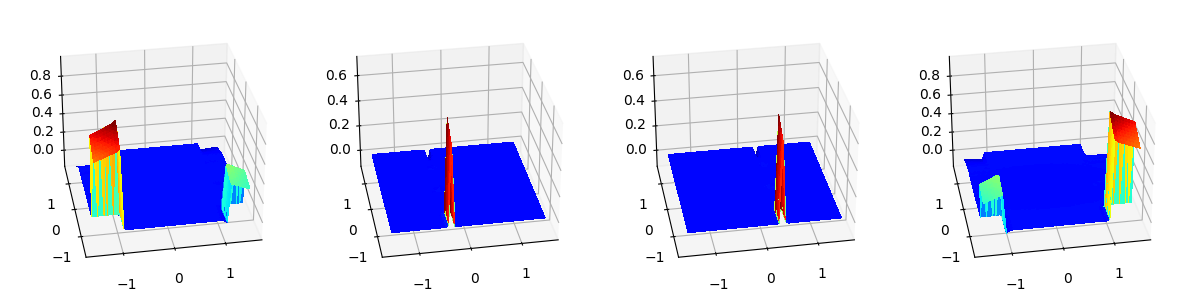
Figure illustrates the concept with an example involving four basis points \(X = \{x^1, x^2, x^3, x^4\}\) and shows the corresponding four partition functions \(\phi^1(Y), \ldots, \phi^4(Y)\). Each function is peaked at its associated center and decays smoothly, yet together they form a partition of unity over the domain.
# Importing necessary modules
import os
import sys

from matplotlib import pyplot as plt

curr_f = os.path.join(os.getcwd(), "codpy-book", "utils")
sys.path.insert(0, curr_f)


import numpy as np

# from codpy.plotting import plot1D
# Lets import multi_plot function from codpy utils
from codpy.plot_utils import multi_plot


# Define the sinusoidal function
def periodic_fun(x):
    """
    A sinusoidal function that generates a sum of sines based on the input ``x``.
    """
    from math import pi

    sinss = np.cos(2 * x * pi)
    if x.ndim == 1:
        sinss = np.prod(sinss, axis=0)
        ress = np.sum(x, axis=0)
    else:
        sinss = np.prod(sinss, axis=1)
        ress = np.sum(x, axis=1)
    return ress + sinss


# Function to generate periodic data
def generate_periodic_data_cartesian(size_x, size_z, fun=None, nabla_fun=None):
    """
    Generates 2D structured Cartesian grid data for x and z domains,
    and evaluates a given function and optionally its gradient.

    Parameters:
    - size_x: number of points per axis for x (grid will be size_x^2)
    - size_z: number of points per axis for z (grid will be size_z^2)
    - fun: function to evaluate at each point
    - nabla_fun: optional gradient function to evaluate

    Returns:
    - x, z: 2D Cartesian grids of shape (N, 2)
    - fx, fz: function values at x and z
    - nabla_fx, nabla_fz (if nabla_fun is provided)
    """

    def cartesian_grid(size, box):
        lin = [np.linspace(box[0, d], box[1, d], size) for d in range(2)]
        X, Y = np.meshgrid(*lin)
        return np.stack([X.ravel(), Y.ravel()], axis=1)

    # Define domain boxes
    X_box = np.array([[-1, -1], [1, 1]])
    Z_box = np.array([[-1.5, -1.5], [1.5, 1.5]])

    # Generate Cartesian grids
    x = cartesian_grid(size_x, X_box)
    z = cartesian_grid(size_z, Z_box)

    # Function evaluations
    fx = fun(x).reshape(-1, 1) if fun else None
    fz = fun(z).reshape(-1, 1) if fun else None

    if nabla_fun:
        nabla_fx = nabla_fun(x)
        nabla_fz = nabla_fun(z)
        return x, z, fx, fz, nabla_fx, nabla_fz

    return x, fx, z, fz


# Lets define helper function to plot 3D projection of the function
def plot_trisurf(xfx, ax, legend="", elev=90, azim=-100, **kwargs):
    from matplotlib import cm

    """
    Helper function to plot a 3D surface using a trisurf plot.

    Parameters:
    - xfx: A tuple containing the x-coordinates (2D points) and their
      corresponding function values.
    - ax: The matplotlib axis object for plotting.
    - legend: The legend/title for the plot.
    - elev, azim: Elevation and azimuth angles for the 3D view.
    - kwargs: Additional keyword arguments for further customization.
    """

    xp, fxp = xfx[0], xfx[1]
    x, fx = xp, fxp

    X, Y = x[:, 0], x[:, 1]
    Z = fx.flatten()
    ax.plot_trisurf(X, Y, Z, antialiased=False, cmap=cm.jet)
    ax.view_init(azim=azim, elev=elev)
    ax.title.set_text(legend)


# import CodPy's core module and Kernel class
from codpy import core
from codpy.kernel import Kernel


def fun_part():
    """
    Runs the experiment applying CodPy and SciPy models on the data and plots the results.

    Parameters:
    - data_x: List of generated x arrays.
    - data_fx: List of function values corresponding to each x.
    - data_z: List of generated z arrays.
    """
    # Apply CodPy and SciPy models for each (x, fx, z) pair

    x, fx, z, fz = generate_periodic_data_cartesian(50, 50)

    kernel = Kernel(
        set_kernel=core.kernel_setter("tensornorm", "scale_to_unitcube"),
        x=x,
        y=x,
        order=2,
        reg=1e-8,
    )
    partxxz = kernel(z).T
    temp = int(np.sqrt(z.shape[0]))

    multi_plot(
        [(z, partxxz[0, :]), (z, partxxz[int(temp / 3), :])]
        + [(z, partxxz[int(temp * 2 / 3), :]), (z, partxxz[temp - 1, :])],
        plot_trisurf,
        projection="3d",
        elev=30,
        mp_nrows=1,
        mp_figsize=(12, 3),
    )
    plt.show()


fun_part()
Total running time of the script: (0 minutes 2.333 seconds)