Note
Go to the end to download the full example code.
5.3.3 Kernel Conditional Density
We illustrate in this experiment the difference in density models of both the kernel-ridge and the Nadaraya-Watson approaches. To assess the ability to capture nonlinear patterns while estimating conditional densities, this experiment considers synthetic data from a heteroskedastic model, involving a uniform law \(X \sim \mathcal{U}(-1, 1)\), and a Gaussian one for \(Y\) with data
Required imports
import matplotlib.pyplot as plt
import numpy as np
from scipy.stats import norm

import codpy.core
from codpy.conditioning import ConditionerKernel, NadarayaWatsonKernel
from codpy.core import kernel_setter
from codpy.utils import cartesian_outer_product, get_matrix

codpy.core.KerInterface.set_verbose()
Generating the data
The data is generated according to the chapter 5.3.3 of the book. - Illustrative example.
def mean_function_hard(x):
    return np.cos(np.pi / 2 * x)
    # return np.sin(np.pi * x)


def variance_function(x):
    return 0.1 * np.cos(np.pi * x * 0.5)


def mean_function(x):
    return 0.1 * np.cos(np.pi * x * 0.5)


def variance_function_hard(X):
    return 0.3 - 0.1 * mean_function(X)


def generate_conditional_hetero_skedastic_density_data(
    N_train=1000, seed=None, mean_f=None, variance_f=None
):
    """
    Generate synthetic data with nonlinear and heteroscedastic structure.

    Parameters:
    - N_train: Number of training samples (X, Y)
    - seed: Random seed for reproducibility
    - mean_f: Callable for mean function, e.g., mean_function(x)
    - variance_f: Callable for variance function, e.g., variance_function(x)

    Returns:
    - x: Training input samples (1D array)
    - y: Training output samples (1D array)
    - z: Test input sample (scalar)
    - y_pdf: Grid of y values for PDF estimation
    - (fz_mean, fz_std): True conditional mean and std at z
    - density: True conditional density at z over y_pdf
    """
    if seed is not None:
        np.random.seed(seed)

    if mean_f is None:
        mean_f = mean_function
    if variance_f is None:
        variance_f = variance_function

    x = np.random.uniform(-1.0, 1.0, N_train)
    mean_y = mean_f(x)
    std_y = variance_f(x)

    y = np.random.normal(loc=mean_y, scale=std_y)

    z = 0.0
    fz_mean = mean_f(z)
    fz_std = variance_f(z)

    y_pdf = np.linspace(2.0 * y.min(), 2.0 * y.max(), N_train)
    density = norm.pdf(y_pdf, loc=fz_mean, scale=fz_std)
    density /= density.sum(axis=0)

    return x, y, z, y_pdf, (fz_mean, fz_std), density


x, y, z, y_pdf, (fz_mean, fz_std), density = (
    generate_conditional_hetero_skedastic_density_data(
        N_train=1000,
        seed=None,
        mean_f=mean_function,
        variance_f=variance_function,
    )
)
Plotting the data
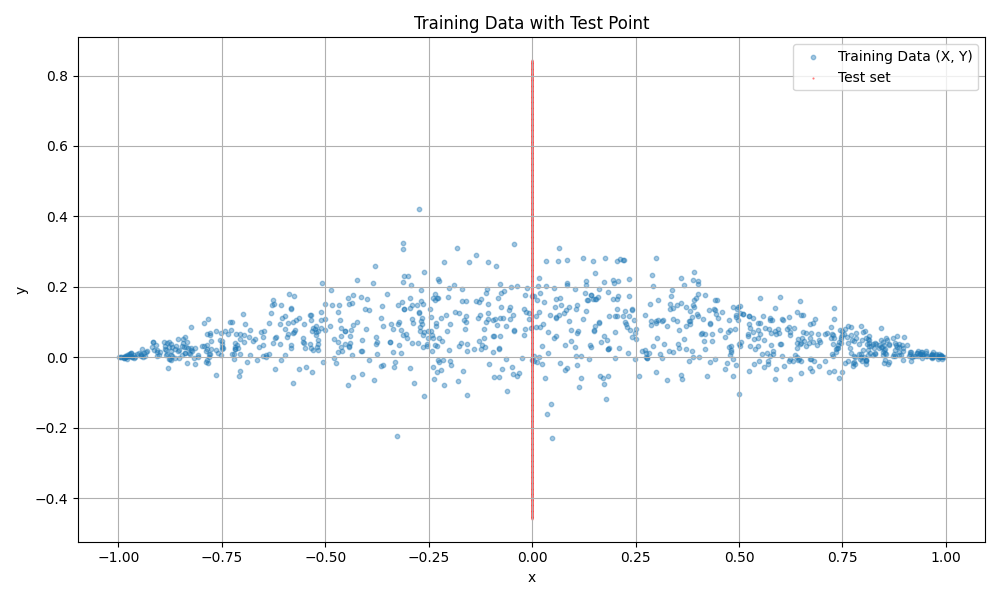
We plot the data with the test points z and true conditional density p(y | z).
def plot_data_with_test_point(x, y, z, y_pdf):
    plt.figure(figsize=(10, 6))
    plt.scatter(x, y, alpha=0.4, label="Training Data (X, Y)", s=10)

    # Mark test point z
    out = cartesian_outer_product(get_matrix(z), get_matrix(y_pdf)).squeeze()
    plt.scatter(out[:, 0], out[:, 1], color="red", label="Test set", s=0.3, alpha=0.5)

    plt.title("Training Data with Test Point")
    plt.xlabel("x")
    plt.ylabel("y")
    plt.legend()
    plt.grid(True)
    plt.tight_layout()
    plt.show()


plot_data_with_test_point(x, y, z, y_pdf)
Estimators
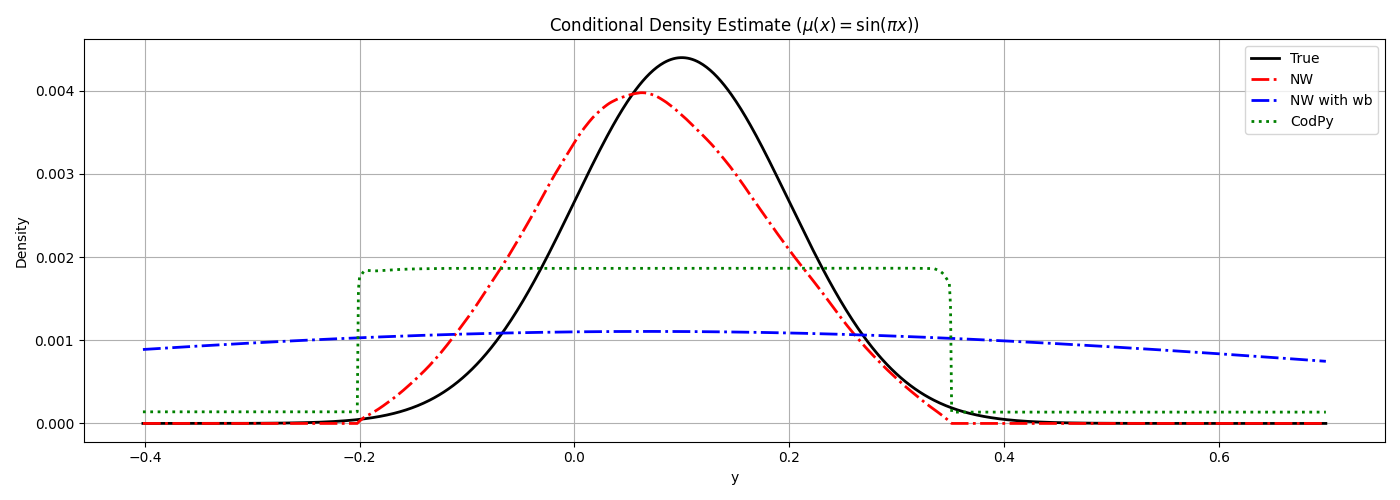
We now use Nadaraya-Watson, CodPy’s Conditioner, and KDE to estimate the conditional density.
x, y, y_pdf, z = (
    x.reshape(-1, 1),
    y.reshape(-1, 1),
    y_pdf.reshape(-1, 1),
    np.array(z).reshape(-1, 1),
)


# For Kde, we use NadarayaWatsonKernel with the map set to bandwith.
nw = NadarayaWatsonKernel(
    x=x,
    y=y,
    set_kernel=kernel_setter(kernel_string="gaussian",kernel_args= {"bandwidth", 12}),
)
kde_result = nw.joint_density(y_pdf, z)
kde_result = kde_result.reshape(-1, 1)
kde_result /= kde_result.sum(axis=0)

# Without any specific kernel and maps, the default NadarayaWatson is used.

X_eval = np.linspace(-1, 1, 1000)
kde_bandwidth = 13
# kde_model = NadarayaWatsonKernel(
#     x=x, y=y, set_kernel=kernel_setter("gaussian", "bandwidth", bandwidth=kde_bandwidth)
# )
# mean_codpy = kde_model.expectation(
#     X_eval,
#     reg=0.1,
# )
codpy_model = ConditionerKernel(x=x, y=y)
mean_codpy = codpy_model.expectation(X_eval, reg=1.5)


# y_demeaned = y.reshape(-1, 1) - mean_codpy.reshape(-1, 1)

# nw = NadarayaWatsonKernel(x=x, y=y_demeaned)
nw = NadarayaWatsonKernel(x=x, y=y)
nw_result = nw.joint_density(y_pdf, z)
nw_result = nw_result.reshape(-1, 1)
nw_result /= nw_result.sum(axis=0)


codpy = ConditionerKernel(x=x, y=y)
codpy_result = codpy.get_transition(y=y_pdf, x=z)
codpy_result /= codpy_result.sum(axis=0)
Plotting the results
def plot_conditional_estimates(y_pdf, true_density, nw, kde, codpy, z):
    plt.figure(figsize=(10, 6))

    plt.plot(y_pdf, true_density, "k-", lw=2, label=f"True $p(y|z={z.item():.2f})$")
    plt.plot(y_pdf, nw, "r--", lw=2, label="Nadaraya-Watson")
    plt.plot(y_pdf, kde, "b-.", lw=2, label="Nadaraya-Watson (with bandwidth)")
    plt.plot(y_pdf, codpy, "g:", lw=2, label="CodPy ConditionerKernel")

    plt.title(f"Estimated Conditional Densities at z = {z.item():.2f}")
    plt.xlabel("y")
    plt.ylabel("Density")
    plt.legend()
    plt.grid(True)
    plt.tight_layout()


fig, axes = plt.subplots(1, 1, figsize=(14, 5))
X_eval = np.linspace(-1, 1, 1000)
kde_bandwidth = 13
z = np.array(0.0).reshape(-1, 1)


x, y, z_scalar, y_pdf, (fz_mean, fz_std), true_density = (
    generate_conditional_hetero_skedastic_density_data(
        N_train=1000,
        seed=3,
        mean_f=mean_function,
        variance_f=variance_function,
    )
)
y_pdf = y_pdf.reshape(-1, 1)
x = x.reshape(-1, 1)
y = y.reshape(-1, 1)
z = np.array(z_scalar).reshape(-1, 1)

# KDE with fixed bandwidth
kde_model = NadarayaWatsonKernel(
    x=x, y=y, set_kernel=kernel_setter(kernel_string="gaussian",kernel_args= {"bandwidth", 12})
)
kde_result = kde_model.joint_density(y_pdf, z)
kde_result /= kde_result.sum()

# Nadaraya-Watson with de-meaned residuals
nw_model = NadarayaWatsonKernel(x=x, y=y)
nw_result = nw_model.joint_density(y_pdf, z)
nw_result /= nw_result.sum()

# CodPy density estimate
codpy = ConditionerKernel(x=x, y=y)
codpy_result = codpy.get_transition(y=y_pdf, x=z)
codpy_result /= codpy_result.sum()

plt.plot(y_pdf, true_density, "k-", lw=2, label="True")
plt.plot(y_pdf, nw_result.reshape(-1, 1), "r-.", lw=2, label="NW")
plt.plot(y_pdf, kde_result.reshape(-1, 1), "b-.", lw=2, label="NW with wb")
plt.plot(y_pdf, codpy_result.reshape(-1, 1), "g:", lw=2, label="CodPy")

plt.title(r"Conditional Density Estimate ($\mu(x) = \sin(\pi x)$)")
plt.xlabel("y")
plt.ylabel("Density")
plt.grid(True)
plt.legend()

plt.tight_layout()
plt.show()

pass
Total running time of the script: (0 minutes 3.737 seconds)