Note
Go to the end to download the full example code.
5.6.d Exploration Data Analysis of the Latent Space: Spherical Data
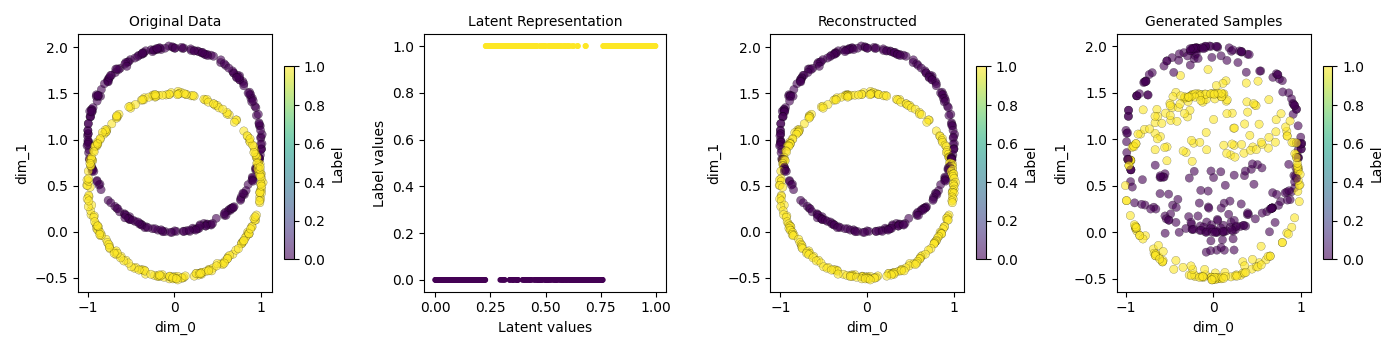
We demonstrate how to tackle the problem of conditional sampling using the Sampler and KernelClassifier classes from CodPy. We generate synthetic spherical data with two cluster, define a Sampler to map a latent representation to the data space, and use a KernelClassifier to assign labels to the generated data.
import numpy as np
import pandas as pd
from matplotlib import pyplot as plt

from codpy import core
from codpy.kernel import Kernel, KernelClassifier, Sampler


def sphere_sampling(center, radius, size, epsilon=0.01):
    from numpy import linalg as la

    samples = np.random.normal(size=size)
    noise = np.random.normal(size=size) * epsilon
    for n in range(samples.shape[0]):
        samples[n] *= radius / la.norm(samples[n])
    samples += noise
    samples += center
    return samples


def generate_sphere_data(N=500, D=2, centers=[[0, 1], [0, 0.5]], radius=1.0):
    num_clusters = len(centers)
    samples_list = []
    labels = []

    for idx, center in enumerate(centers):
        size = (N // num_clusters, D)
        samples = sphere_sampling(center=np.array(center), radius=radius, size=size)
        samples_list.append(samples)
        labels.extend([idx] * (N // num_clusters))

    X = np.vstack(samples_list)
    df = pd.DataFrame(X, columns=[f"dim_{i}" for i in range(D)])
    labels = pd.Series(labels, name="label")
    return df, labels


def scatter_plot_multiple(dfs, titles, figsize=(14, 3.5)):
    """
    Plots a row of scatter plots, with special label visualization for latent variables.
    """

    fig, axes = plt.subplots(1, len(dfs), figsize=figsize)
    if len(dfs) == 1:
        axes = [axes]

    for ax, df, title in zip(axes, dfs, titles):
        if title == "Latent Representation":
            # Show label predictions as a 1D classification result
            ax.scatter(df.values[:,0], df["label"], c=df["label"], cmap="viridis", s=10)
            ax.set_ylabel("Label values")
            ax.set_xlabel("Latent values")
        else:
            sc = ax.scatter(
                df["dim_0"],
                df["dim_1"],
                c=df["label"],
                cmap="viridis",
                alpha=0.6,
                edgecolor="k",
                linewidth=0.2,
            )
            ax.set_xlabel("dim_0")
            ax.set_ylabel("dim_1")
            # Optional: show color bar
            cbar = plt.colorbar(sc, ax=ax, shrink=0.75)
            cbar.set_label("Label")

        ax.set_title(title, fontsize=10)

    plt.tight_layout()
    plt.show()


def simple_hot_encoder(y_label,num_classes=None):
    y_label = np.asarray(y_label)
    if num_classes is None:
        num_classes = np.max(y_label) + 1
    out = np.zeros((y_label.shape[0], num_classes))
    out[np.arange(y_label.shape[0]), y_label] = 1
    return out


def assign_labels_by_projection(circles, latent, z, latent_label, sampler, **kwargs):
    """
    Assign labels to latent and sampled points using kernel class + softmaxindice.
    """

    # 1. Encode original labels
    fx_encoded = simple_hot_encoder(latent_label)  # fx_encoded shape: (N, C)

    kernel = KernelClassifier(
        x = circles,
        fx=fx_encoded,
        set_kernel=core.kernel_setter("maternnorm", "standardmean"),
        clip=None
    )
    # 2. Projection of latent points
    latent_proj = kernel(sampler(z=latent))

    # 3. Projection of sampled points
    variate_proj = kernel(z=z)

    return latent_proj.argmax(1), variate_proj.argmax(1)


def run_sampler_on_sphere_with_projection(method = "combinatorial"):
    # Generate original data
    y_df, y_labels = generate_sphere_data(
        N=499, D=2, centers=[[0, 1], [0, 0.5]], radius=1.0
    )
    circles = y_df.values
    # Fit the sampler
    sampler = Sampler(x=circles, latent_generator = lambda n: np.array(range(n))/n, distance = "norm22", method=method)
    # sampler = Sampler(x=circles, latent_generator = lambda n: np.array(range(n))/n, distance = "norm22")
    # sampler = Sampler(x=circles,iter=10,latent_dim=1)
    import matplotlib.pyplot as plt
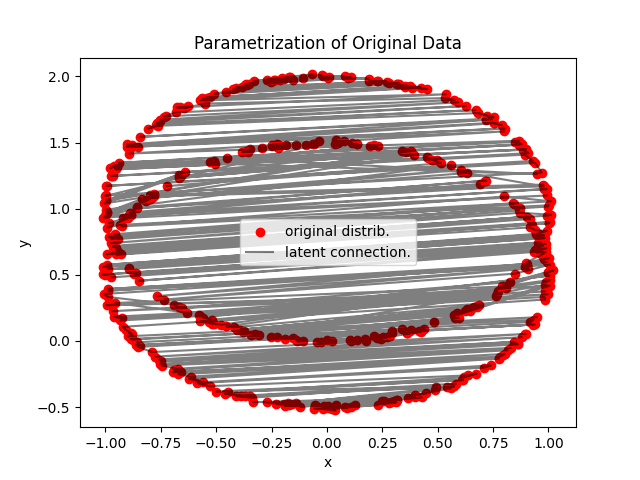
    plt.scatter(sampler.get_fx()[:, 0], sampler.get_fx()[:, 1], color='red', label="original distrib.")
    plt.plot(sampler.get_fx()[:, 0], sampler.get_fx()[:, 1], alpha=0.5,color='black', label="latent connection.")
    plt.ylabel("y")
    plt.xlabel("x")
    plt.title("Parametrization of Original Data")
    plt.legend()

    plt.show()
    # New generated samples
    uniform = np.random.uniform(size=(500, 1))
    variate = pd.DataFrame(
        sampler(uniform), columns=[f"dim_{i}" for i in range(circles.shape[1])]
    )
    # Latent
    latent = sampler.get_x()
    latent = pd.DataFrame(
        latent, columns=[f"dim_{i}" for i in range(latent.shape[1])]
    )
    # Reconstructed

    y_recon = pd.DataFrame(sampler.get_fx(), columns=[f"dim_{i}" for i in range(circles.shape[1])])
    # Classifier
    fx_encoded = simple_hot_encoder(y_labels.values)  # fx_encoded shape: (N, C)

    kernel = KernelClassifier(
        x = circles,
        fx=fx_encoded,
        set_kernel=core.kernel_setter("maternnorm", "standardmean"),
        clip=None
    )
    # 2. Latent labels
    latent_label=kernel(y_recon.values).argmax(1)

    # 3. Projection of sampled points
    variate_label = kernel(variate.values).argmax(1)

    # Assign labels

    # Attach labels
    latent["label"] = latent_label
    y_recon["label"] = latent_label
    variate["label"] = variate_label
    original = y_df.copy()
    original["label"] = y_labels

    scatter_plot_multiple(
        [original, latent, y_recon, variate],
        titles=[
            "Original Data",
            "Latent Representation",
            "Reconstructed",
            "Generated Samples",
        ],
    )


# core.KerInterface.set_verbose()
run_sampler_on_sphere_with_projection(method = "OT")
pass
Total running time of the script: (0 minutes 1.135 seconds)