Note
Go to the end to download the full example code.
9.08 Stochastic volatility model
We reproduce here the figure 9.9 of the book. Utilitary functions can be found next to this file. Here, we only define codpy-related functions.
Necessary Imports
import os
import sys

import matplotlib.pyplot as plt
import numpy as np

from codpy.kernel import Sampler

try:
    CURRENT_DIR = os.path.dirname(os.path.abspath(__file__))
except NameError:
    CURRENT_DIR = os.getcwd()
data_path = os.path.join(CURRENT_DIR, "data")
PARENT_DIR = os.path.abspath(os.path.join(CURRENT_DIR, ".."))
sys.path.insert(0, PARENT_DIR)

import utils.ch9.mapping as maps
from utils.ch9.market_data import retrieve_market_data
from utils.ch9.path_generation import generate_paths
from utils.ch9.plot_utils import display_historical_vs_generated_distribution
Parameter definition
def get_cdpres_param():
    return {
        "rescale_kernel": {"max": 2000, "seed": None},
        "rescale": True,
        "grid_projection": True,
        "reproductibility": False,
        "date_format": "%d/%m/%Y",
        "begin_date": "01/06/2020",
        "end_date": "01/06/2022",
        "today_date": "01/06/2022",
        "symbols": ["AAPL", "GOOGL", "AMZN"],
    }
Get the market data
params = retrieve_market_data()
Defining the map
This model augments the conditioning model by adding a stochastic volatility term :
\[\begin{split}\begin{split}
\ln X^{k+1} &= \ln X^k + \varepsilon_X^k \mid \sigma^k, \\
\sigma^{k+1} &= \sigma^k + \varepsilon_\sigma^k \mid \sigma^k,
\end{split}\end{split}\]
where \(\varepsilon^k = (\varepsilon_X^k, \varepsilon_\sigma^k)\) are the noise components for the process and volatility, respectively. These are sampled using conditional generators \(G_k^X(\cdot \mid \sigma^k)\) and \(G_k^\sigma(\cdot \mid \sigma^k)\).
params["map"] = maps.composition_map(
    (
        maps.VarConditioner_map(params),
        maps.add_variance_map(var_q=10),
        maps.log_map,
        maps.remove_time(),
    )
)
params = maps.apply_map(params)
We define our sampler on the mapped data using codpy’s Sampler
You can define your own latent generator function, here we use a simple uniform distribution. But if not provided, a default one will be used by the Sampler class.
mapped_data = params["transform_h"].values
generator = lambda n: np.random.uniform(size=(n, mapped_data.shape[1]))
sampler = Sampler(mapped_data, latent_generator=generator)
params["sampler"] = sampler
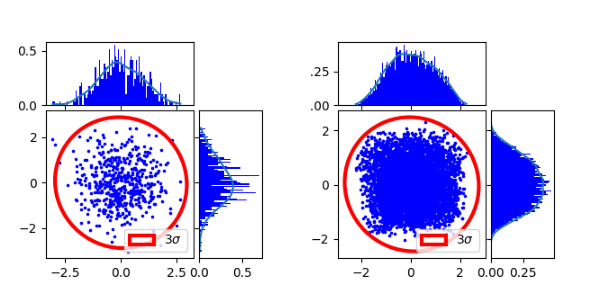
We plot the original distribution vs the generated one
params = display_historical_vs_generated_distribution(params)
params["graphic"](params)
plt.show()
Reproductibility test
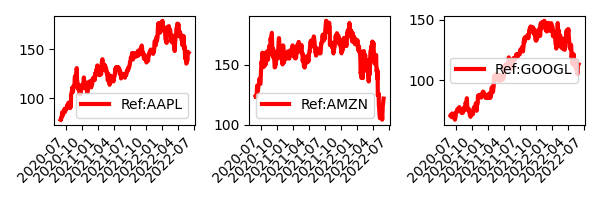
We regenerate the same path by generating from the latent representation We make sure we get the original data back.
params["reproductibility"] = True
params = generate_paths(params)
params["graphic"](params)
plt.show()
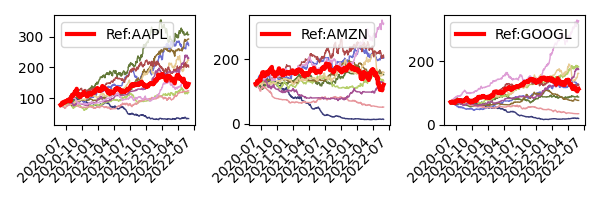
We now generate a new set of 10 paths
params["reproductibility"] = False
params["Nz"] = 10
params = generate_paths(params)
params["graphic"](params)
plt.show()
pass
Total running time of the script: (0 minutes 4.266 seconds)