Note
Go to the end to download the full example code.
7.01 Inverse Laplace Operator
We reproduce here the figure 7.1 and 7.2 of the book. Utilitary functions can be found next to this file. Here, we only define codpy-related functions.
Necessary Imports
import os
import sys

import matplotlib.pyplot as plt
from codpy import core

try:
    CURRENT_DIR = os.path.dirname(os.path.abspath(__file__))
except NameError:
    CURRENT_DIR = os.getcwd()
data_path = os.path.join(CURRENT_DIR, "data")
PARENT_DIR = os.path.abspath(os.path.join(CURRENT_DIR, ".."))
sys.path.insert(0, PARENT_DIR)

from utils.ch7.ch7_utils import PDE1, PDE2
Problem statement
We solve the following Poisson equation with Dirichlet boundary conditions:
\[\Delta u = f, \quad \text{ supp } u \subset \Omega, \quad u_{\partial \Omega}=0\]
where \(f\) is sufficient regular and \(\Omega\) is a sufficient regular domain.
To do so we select a mesh, and a kernel, which approximates this equation by approximating the solution as a function \(u \in \mathcal{H}_k\)
This leads to the equation \((\Delta_k u)(X) = f(X)\), \(\Delta_k\) being the approximation of the Laplace-Beltrami operator defined in the book.
A solution to this equation is computed as \(u = (\Delta_k)^{-1} f\).
Regular mesh
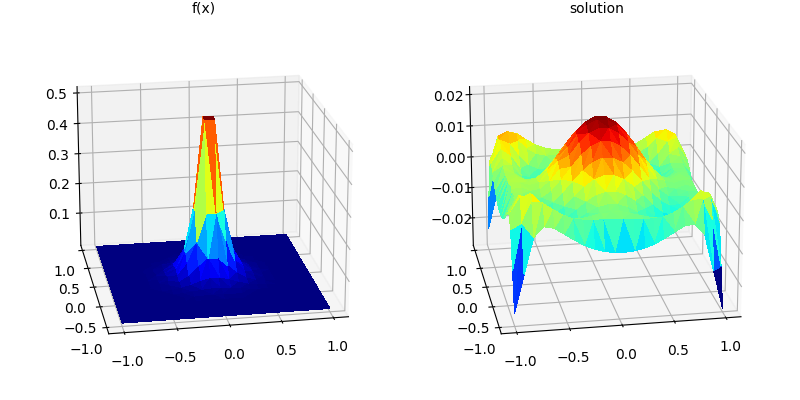
This figure displays a regular mesh for the domain \(\Omega = [0,1]^2\), where \(f\) is plotted in the left-hand side, and the solution \(u\) in the right-hand side.
PDE1()
plt.show()
Irregular mesh
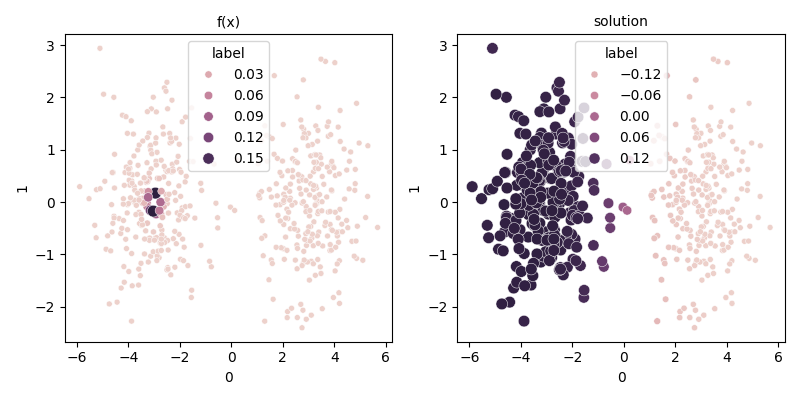
This figure computes a Poisson equation on an unstructured mesh generated by a bimodal Gaussian random variable, with \(f\) plotted on the left and the solution \(u\) on the right.
PDE2()
plt.show()
Total running time of the script: (0 minutes 0.759 seconds)